

A rocket launch is the rare spectacle that rewards a bit of preparation. Not because the event itself is complicated — the rocket does the hard work — but because UK conditions rarely cooperate. Cloud rolls in off the Atlantic, launch windows shift by hours, and the whole thing can be over before you have finished fumbling with your phone.
None of that means you need to be an expert. It means you need a plan, a backup plan, and footwear you don't mind ruining.
Before You Leave: Know What You Are Actually Trying to See
The first question is whether this launch is visible from where you live at all. UK launch activity centres on sites such as SaxaVord on Unst in Shetland, Sutherland in the far north of Scotland, and Spaceport Cornwall at Newquay. These are small rockets on unusual trajectories, often heading north or south along the coast rather than straight up over a crowd. From several miles away, expect a bright moving point and a growing trail, not a Hollywood pillar of flame filling the sky.
Launches from Florida, California or French Guiana are a different matter. You will not see those from a British back garden, however clear the night. Those are livestream events, and the sections below still apply to them.
Check the launch window rather than just the date. Windows can be short, and they can move. Note the backup days too, because a scrub is routine rather than dramatic. Then check for any public viewing arrangements — councils, police and spaceport operators sometimes publish designated spots, road closures and parking restrictions. Local community pages usually carry the latest word before the official channels do.
Pack a bag the night before:
- Layers, waterproofs and a hat — coastal sites are cold even in summer
- Torch or head torch with spare batteries (red light if you can manage it)
- Power bank and charging cable
- Flask, snacks, something to sit on
- Tripod if you intend to photograph anything
- Offline maps — mobile signal is patchy on headlands and moors
Pick a Spot With an Open Horizon and a Legal Parking Space
Sea horizon beats hills every time. An elevated viewpoint with nothing between you and the direction of flight is ideal, and the further you are from streetlights, the better the contrast. If the rocket is heading north, you want to be looking north; a beach facing the wrong way is just a cold beach.
Park legally. Laybys on fast A-roads, farm gateways and emergency access points are not parking spaces, and a launch night is exactly when you do not want to be the reason someone cannot get through. In England and Wales, stick to public rights of way and open access land. Scotland's access rights are broader, but closures around launch sites still apply and should be respected.
On the coast, check tide times before you commit to a beach. Some of the best-looking vantage points disappear under water with no drama at all, and a retreat along a wet causeway is not the memory you want.
Weather: The Thing That Decides Your Night
Cloud is the enemy. A forecast summary of "partly cloudy" tells you almost nothing, so look at hour-by-hour cloud cover percentages and, if you can, a satellite loop showing where the cloud is actually moving. Clear skies two hours before the window mean little if a front is due at the same time as ignition.
Wind matters less for your viewing than for the launch itself, but a stiff onshore breeze can drag low cloud in quickly. Rain is mostly a problem for you and your kit. Remember that it can be perfectly clear overhead and still be a scrub — launch providers have their own weather rules covering upper-level winds, electric fields and range conditions, and they will not bend them for a nice evening.
Livestreams and Timing: Set Up Your Backups
Assume the schedule will slip. Delays of minutes are normal, holds of an hour are not unusual, and scrubs happen. Give yourself a buffer, set a second alarm, and know the difference between the published window opening and the actual T-0.
For the stream itself:
- Open the operator's own channel first — it is the primary source.
- Have one independent feed ready in case the main one drops.
- Charge a second device or bring a power bank; streams eat battery.
- Keep notifications on for launch updates, but mute the commentary until it matters.
- Check local radio — BBC stations in launch regions often carry live updates.
If you are near the launch site, the stream is there to tell you when, not what. Put the phone down at T-30 seconds.
During the Countdown: Watch the Sky, Not the Screen
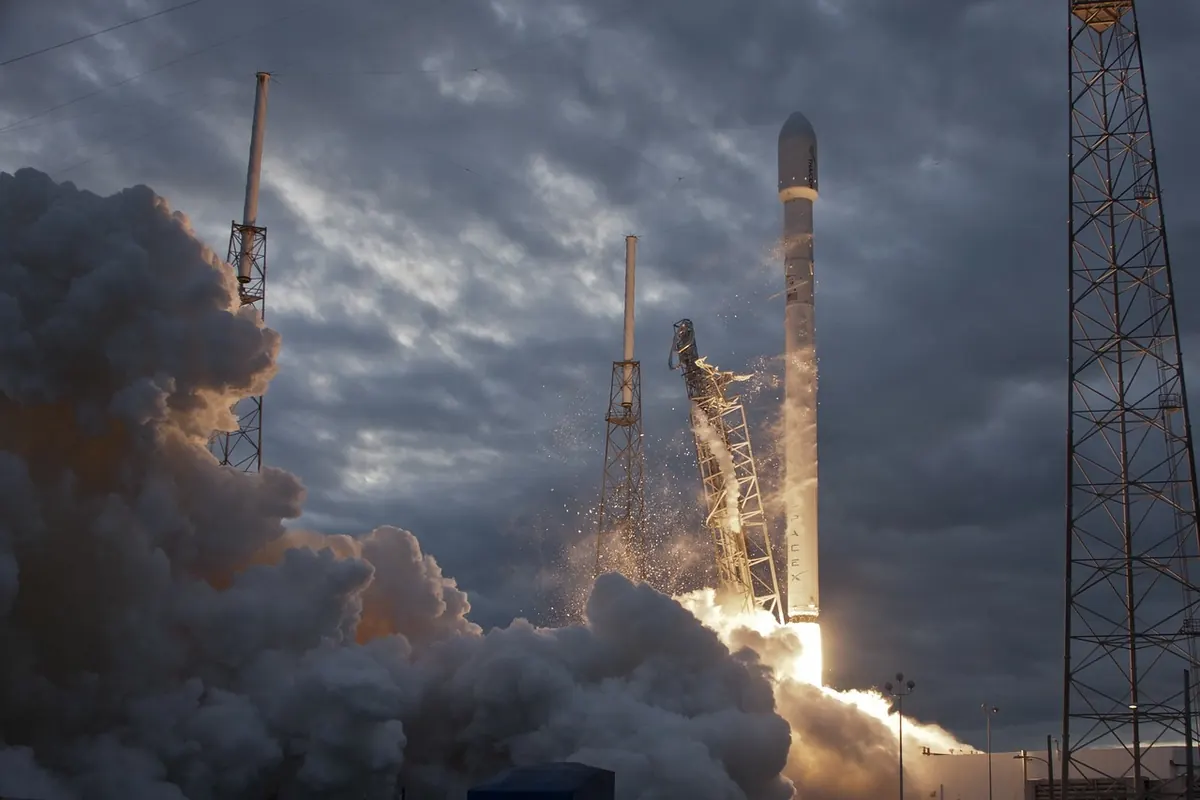
Keep your eyes on the horizon in the direction of the pad. Ignition appears as a sudden brightening, sometimes with a bloom of light on low cloud. Silence afterwards is entirely normal: sound takes roughly five seconds to cover each mile, so a launch twenty miles away will be heard well over a minute late. The rumble is the delayed reward, and it is usually deeper and stranger than people expect.
If you are photographing, a tripod and a wide lens on a long exposure will capture a streak rather than a rocket. Binoculars narrow the field a lot; they are better for tracking a trail than for finding the moment of ignition. If you are watching purely online, the best parts are often stage separation and the on-board camera, so keep the volume sensible.
After the Launch: Capture What You Saw
Once the engine cuts, the trail spreads and slowly loses its shape. In twilight, and especially when the ground is already in shadow but the upper atmosphere is still sunlit, that plume can brighten into the wide, fan-like display people call a jellyfish. The same geometry produces the illuminated clouds that appear after a launch near dusk, so stay watching for a few minutes rather than packing up straight away.
Write down what you saw within a few minutes — the time, the direction, the colour, how long it lasted. Memory blurs quickly, and a short note turns a vague memory into something you can compare with the replay. Check the official stream later to confirm whether what you saw was the first stage, a second-stage burn or a re-entry. If you took photographs, keep the originals; a rocket forty miles away is a small, dim object, and heavy editing rarely rescues it.
The Short Version
If you remember nothing else: confirm the launch is visible from where you are, find a legal spot with an open horizon, check hourly cloud rather than a daily summary, arrive early with layers and a charged power bank, keep a livestream open as a timer, then put the screen away and look up. Note the time afterwards and check the replay.
And if it scrubs, that is not failure. Waiting is most of this hobby, and the part that isn't waiting tends to be worth the trip.
Photo: StockSnap / Pixabay